
RENTING OUT YOUR HOME – AND THE CGT AND NEGATIVE GEARING CHANGES
One of the many areas where the big changes to negative gearing and Capital Gains Tax may have an effect is where you use the “absence concession” to allow you to “continue to treat” your home as your CGT-free main residence during an extended absence from the home – including where you rent it out for up to 6 years during this period.

FAMILY TRUSTS
Time to Get Some Timely Advice
Trust income will now be taxed to the trust at a ultimately distributed to beneficiaries. However, under the proposed measures, individual beneficiaries to whom that trust income is later distributed will get a credit for the tax paid by the trust to prevent double taxation. But a credit will not be available where this trust income is distributed to a corporate beneficiary.
These measures are due to start on 1 July 2028 but no doubt will be subject to tremendous scrutiny in the meantime before any final legislation is passed. Nevertheless, it is never too early to start looking at things and making some plans.
The other major thing that happened that affects family trust was a decision of the High Court in Bendel’s case. And that decision applies immediately.

Federal Budget 2026-27
1. Fundamental reforms to the CGT regime
1.1 Replacing the 50% CGT discount with indexation
From 1 July 2027, the 50% CGT discount will be replaced by cost base indexation for assets held for more than 12 months, with a 30% minimum tax on net capital gains. These changes will apply to all assets, including pre-CGT assets, held by individuals, trusts and
partnerships.
Transitional arrangements will limit the impact on existing investments by ensuring the changes only apply to gains accruing on or after 1 July 2027. The 50% CGT discount will continue to apply to gains that accrued before 1 July 2027. Capital gains on pre-CGT assets that accrued before 1 July 2027 will remain exempt from CGT.
Furthermore, investors in new residential properties will be able to choose either:
- the 50% CGT discount; or
- cost base indexation and the 30% minimum tax.
Income support payment recipients, including Age Pension recipients, will be exempt from the minimum tax.
Assets that are sold prior to 1 July 2027 will continue to be subject to the existing rules.

Budget musings: Changes to Negative Gearing, the CGT Discount on the Cards
Even before the current war in the Middle East, the Budget has clearly been under some pressure. Recent comments from various government sources suggest that changes to the tax rules around investment properties could be under serious consideration.
So, what sort of changes could we see on 12th May? And how might they affect you?
While there has been a lot of focus on the offset rental losses against other income, such a salary and wages. Most other countries don’t permit this.
The 50% discount Arguments have been advanced that the 50% discount is too generous, especially for assets that have not been held for a long time, and there are calls for reducing the discount to 33 ⅓ % or even 25%.

Div 296 Tax is Now Law: What It Means for Your Super
There’s been alot of talk about changes to super, and one of the biggest updates is now official.
The government has passed the Division 296 tax, which will start from 1 July 2026. While it mainly affects people with large super balances, it’s still important to understand what’s changing and why.
When this tax was first proposed back in 2023, it caused quite a stir. The original plan included:
» Taxing unrealised gains (basically, increases in value on paper that you haven’t actually received yet)
» A $3 million threshold that wasn’t going to increase over time
Understandably, many peoplewereconcernedthis wasn’t fair. After strong feedback, the governmenthasrevised the rules. The final legislated version alignsmore closely with how tax usually works, thatbeing, taxation of actual income not paper gains.

Payday Super Checklist for Employers: Steps to Stay Compliant
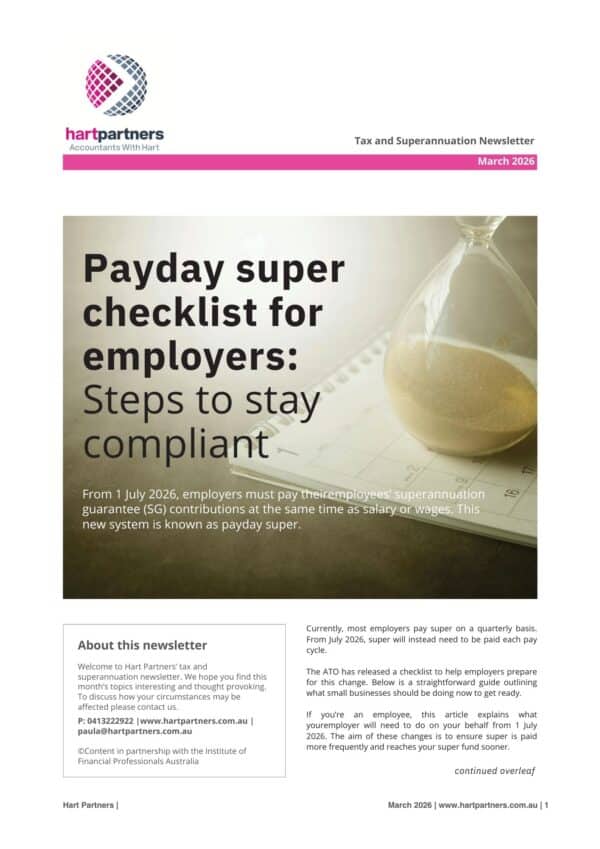
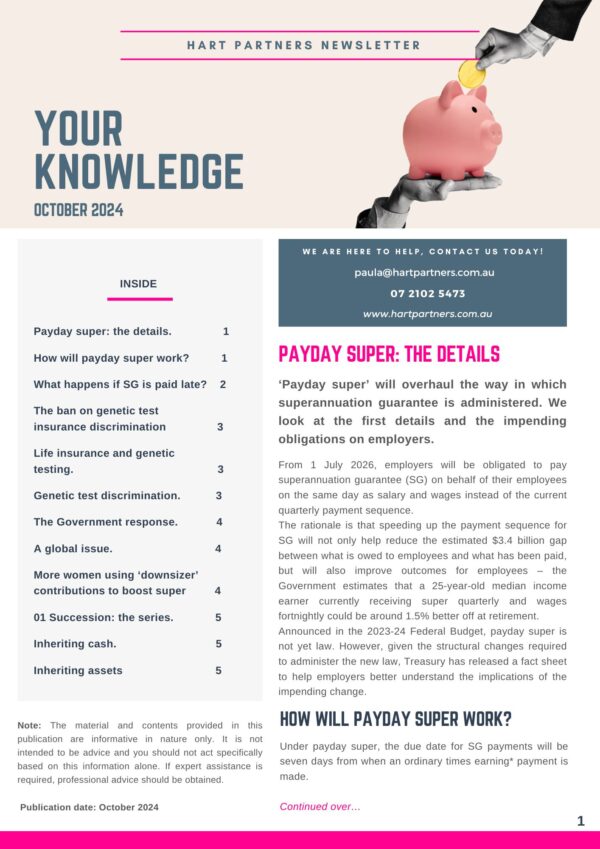
From 1 July 2026, employers must pay theiremployees’ superannuation guarantee (SG) contributions at the same time as salary or wages. This new system is known as payday super.
Currently, most employers pay super on a quarterly basis. From July 2026, super will instead need to be paid each pay cycle. The ATO has released a checklist to help employers prepare for this change. Below is a straightforward guide outlining what small businesses should be doing now to get ready.
If you’re an employee, this article explains what youremployer will need to do on your behalf from 1 July 2026. The aim of these changes is to ensure super is paid more frequently and reaches your super fund sooner.
Change to the Tax Treatment of Holiday Homes
No doubt noting the growing trend for people to rent out property for short-term accommodation, the ATO has withdrawn a 40-year old ruling and replaced it with a new draft Taxation Ruling accompanied by two draft Practical Compliance Guidelines that between them cover everything relating to renting out all or part of your property without carrying on a business, including income and deductions in a variety of circumstances.

Note: The material and contents provided in this publication are informative in nature only. It is not intended to be advice and you should not act specifically on the basis of this information alone. If expert assistance is required, professional advice should be obtained.






























SIGN-UP FOR EXCLUSIVE VIDEOS, ARTICLES, NEWSLETTER AND HELPFUL TIPS!
We promise, no spam.
We respect your privacy and will never share your information with a third party.